
How to Play Mega Block Game: Complete Rules & Step-by-Step Guide 2026
Everything you need to understand Mega Block's mechanics — from your first bet to advanced timing techniques. Covers all four difficulty levels, the provably fair system, auto-game mode, and practical advice that the official rules page won't tell you.
Understanding the Basics: What Is Mega Block and How Does It Work?
Mega Block is a tower-building instant-win game developed by Inout Games, released on 10 February 2026. It operates on a simple core loop: you drop blocks onto a growing tower, and each block you land successfully increases your multiplier. Miss a block, and the round ends with your bet lost. Cash out at any point to collect your winnings at whatever multiplier you have reached.
What separates Mega Block from almost every other crash-style game on the market is the timing mechanic. Your block does not simply appear on the tower — it swings above on a pendulum arc. You watch the block travel back and forth across the screen and press the Drop button at the precise moment it passes over the tower below. The timing window is not forgiving. If the block's centre falls outside the tower's edges when you drop it, the block misses and the round is over.
This creates a game that feels genuinely skill-adjacent, even though the underlying outcome is governed by a cryptographically determined random number. The pendulum speed, the acceptable timing window for each difficulty level, and the multiplier assigned to each successful block are all pre-determined by the server seed before the round starts. Your skill at timing affects how far into the sequence you progress, but the difficulty of each individual drop is set in advance.
Inout Games launched in 2024 with a Curacao gaming licence and has grown to over 30 game titles. Mega Block draws players looking for an alternative to Aviator's passive multiplier-watching format — you can see how Mega Block compares to Tower Rush, the other major title in the tower-building category. The game is HTML5-based and requires no download — it loads directly in any modern web browser on desktop, tablet, or mobile.
The Core Mechanic in Plain English
Picture a stack of blocks on a platform. Above the stack, a new block swings left and right on a pendulum, like the blade of a clock. Your job is to press a button at the exact moment the swinging block is centred above the stack. If you time it correctly, the block lands on top of the tower and your multiplier jumps to the next value in the sequence. If you misjudge and press too early or too late, the block swings past the tower's edge and falls — the round is over, your bet is forfeited.
The multiplier ladder for each difficulty is pre-set. On Easy mode, your first successful block lands at 1.01x, and each subsequent block increases the multiplier through a fixed sequence up to 23.75x if you land all 24 blocks. On Hardcore, the sequence starts at 1.6x and can reach 2,941,884x if you achieve all 15 blocks — a sequence that demands near-perfect timing across every single drop.
At any point after your first successful block, you can press the Cash Out button to lock in your current multiplier and receive that multiple of your original bet. This cash-out option is what converts this instant-win game from a binary win-or-lose experience into a risk-management exercise. The central question every round is not just "can I make this drop" but "should I take what I have now, or risk it for the next level?"
Key Facts at a Glance
| Fact | Detail |
|---|---|
| Developer | Inout Games (Curacao licensed, est. 2024) |
| Release Date | 10 February 2026 |
| RTP | 95.5% (house edge: 4.5%) |
| Bet Range | €0.10 to €100 per round |
| Difficulty Levels | Easy, Medium, Hard, Hardcore |
| Maximum Multiplier | 2,941,884x (Hardcore, all 15 blocks) |
| Platform | HTML5 web browser, mobile optimised |
| Fairness System | Provably fair (server seed + client seed + nonce) |
| Special Features | Auto-game mode, session recovery |
Step-by-Step Guide: How to Play Mega Block Game
Follow these seven steps to go from a new player with no account to actively placing bets in Mega Block. Each step includes practical advice beyond the bare minimum.
Choose Your Casino and Register
Mega Block is not available as a standalone app — it is played through online casino platforms that license the game from Inout Games. Your first task is selecting a casino that carries Mega Block and meets your standards for licensing, payment options, and reputation.
When evaluating a casino, check the following before registering:
- Licensing: Look for a valid gaming licence from a recognised authority. MGA-licensed casinos offer the strongest player protections for European residents. Curacao-licensed casinos are more widely available but operate under lighter regulatory oversight.
- Payment methods: Confirm the casino supports deposit methods you use — Visa, Mastercard, PayPal, Skrill, Neteller, or cryptocurrency depending on your preference.
- Withdrawal speed: Check recent reviews for payout processing times. A casino that delays withdrawals is a significant warning sign.
- Mega Block availability: Not all casinos offering Inout Games titles carry every game. Confirm Mega Block appears in the lobby before registering.
Registration typically requires an email address, username, password, date of birth, and your country of residence. Most casinos require identity verification (KYC — Know Your Customer) before processing withdrawals. Submitting your ID documents early avoids delays when you want to cash out.
Our bonuses page lists casinos currently carrying Mega Block alongside their welcome offers. All listed casinos go through our affiliate link — this earns us a commission at no cost to you and helps keep this guide free.
Fund Your Account
Once registered and verified, navigate to the casino's cashier or deposit section. Select your payment method, enter the amount you want to deposit, and confirm the transaction. Most deposits are processed instantly for cards and e-wallets; cryptocurrency deposits typically confirm within one to ten minutes depending on network congestion.
Before depositing, set a clear budget for your Mega Block session. Decide in advance how much you are prepared to lose — not just how much you want to win. This is not a pessimistic framing; it is the practical basis for responsible session management. Mega Block's 4.5% house edge means the expected outcome over a long session is a net loss, regardless of skill or strategy.
Mega Block's minimum bet is €0.10 per round. If you deposit €50 and plan to play 100 rounds on Easy mode at €0.50 per bet, your maximum exposure across those rounds is €50 — but variance means you could exhaust your balance in 20 rounds or run it up to €150 before eventually losing. Set your deposit to an amount that allows meaningful play without creating financial stress.
Check whether your chosen casino offers a welcome bonus applicable to crash games or live casino titles. Many bonuses exclude specific game categories. If a bonus applies, read the wagering requirements carefully — a 30x wagering requirement on a €100 bonus means you must bet €3,000 before withdrawing bonus-derived winnings.
Find Mega Block in the Game Lobby
Log into your casino account and navigate to the game lobby. Use the search bar — type "Mega Block" or "Inout" — or browse the crash games or instant-win section. Mega Block is often categorised under "Crash Games", "Instant Win", or "Inout Games" depending on the casino's library organisation.
Click the game thumbnail to open it. On most casinos you will see two launch options: "Play for Real" and "Demo" (sometimes labelled "Try for Free"). For your first session, launching the demo version before risking real money is strongly recommended. The demo runs identically to the real-money version in terms of mechanics — the only difference is that winnings and losses do not affect your real balance.
Mega Block loads directly in your browser window. There is no download, no plugin, and no installation required. The game uses HTML5 and WebGL technology to render smoothly on both desktop and mobile browsers. On a standard broadband or 4G mobile connection, the game loads in under five seconds.
If you cannot find Mega Block in your casino's lobby, contact support to confirm whether the title is available in your country and whether regional restrictions apply. Inout Games holds a Curacao licence, and access may be restricted in certain jurisdictions — including some EU member states.
Set Your Bet Amount
Before starting a round, you need to set your bet. The bet controls appear at the bottom of the game interface — use the minus and plus buttons to adjust the amount, or type directly into the bet field. The minimum bet is €0.10 and the maximum is €100.
Bet sizing is the single most important decision you make in Mega Block. Because any given round can end on the very first block (particularly on Hard and Hardcore modes), you must size bets appropriately for your bankroll. A commonly recommended starting point is to keep each bet between 0.5% and 2% of your total session bankroll. At 1%, a €50 bankroll means €0.50 bets — which fits comfortably within Mega Block's minimums.
Higher difficulty levels have higher expected variance, which justifies smaller bet sizes. A player using Hardcore mode should use even smaller bets relative to their bankroll than a player using Easy mode, because the probability of losing the round on any given drop is substantially higher — particularly on early drops where the timing tolerance is tightest.
Some casinos apply additional bet limits specific to Mega Block that may differ from Inout Games' standard minimums and maximums. Always verify the limits shown in the game interface after launch, as casino-level restrictions can lower the maximum bet below €100.
Select Your Difficulty Level
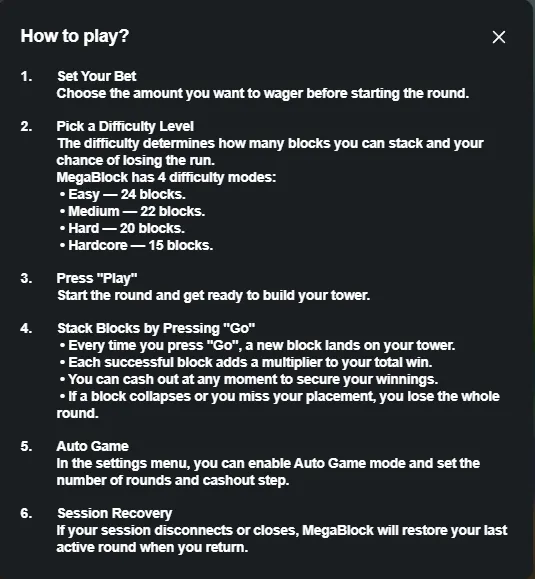
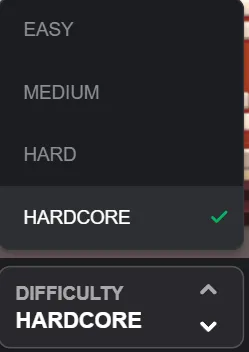
Mega Block offers four difficulty levels, each representing a fundamentally different game experience. The difficulty selector appears before the round starts, typically as four labelled buttons or tabs in the game's control panel. You must select your difficulty before pressing Play — it cannot be changed once a round is in progress.
The four options are:
- Easy: 24 blocks, multiplier range 1.01x to 23.75x. Widest timing tolerance, lowest maximum win.
- Medium: 22 blocks, multiplier range 1.09x to 2,116x. Moderate timing tolerance, significant upside potential.
- Hard: 20 blocks, multiplier range 1.2x to 48,348x. Narrow timing window, high variance.
- Hardcore: 15 blocks, multiplier range 1.6x to 2,941,884x. Tightest timing window, extreme variance.
For new players, Easy is the correct choice until you develop reliable block-timing instincts. The lower maximum multiplier is a reasonable trade-off for learning the game's rhythm without burning through your bankroll in rapid successive losses. See the Difficulty Levels in Detail section below for a complete breakdown of each option.
For a visual guide to the selector interface, see the screenshot below.
Start Playing: Time Your Block Drops
Press the Play or Start button to begin the round. The game screen displays your tower at the bottom and the first block swinging above it on a pendulum. Watch the block's movement carefully before pressing Drop for the first time — get a feel for the rhythm of the swing, which is consistent throughout the round.
Each block moves in a smooth arc from left to right, then back from right to left. It passes directly over the tower once per swing. You need to press the Drop button — or tap the screen on mobile — at the exact moment the block's centre is over the tower. Mega Block calculates whether the drop was successful based on how much of the block overlaps with the top of the tower at the moment of release.
On Easy mode, the timing window is wide enough that you have a comfortable margin for error. On Hardcore, the acceptable range shrinks significantly — a fraction of a second's mistiming will cause the block to miss. As the tower grows taller, the pendulum's arc remains consistent in speed, but the visual reference point changes because the tower's top surface gets closer to the swinging block's travel path.
After a successful drop, the multiplier display updates to show your current payout if you were to cash out now. The game pauses briefly between blocks — this is your window to decide whether to continue or cash out. There is no time pressure to decide immediately; the next block does not begin swinging until you either click to continue or press Cash Out.
On mobile, use your thumb to tap the centre of the screen rather than the button at the screen edge. The game is optimised for thumb-tap input and the hitbox for the Drop action covers the central portion of the screen, not just the button area. This reduces the lateral movement required between watching the block and tapping to drop it.
Cash Out or Continue Building
After each successful block placement, you face a binary decision: cash out at your current multiplier, or attempt the next block at the risk of losing everything. This decision — repeated up to 24 times in a single round on Easy mode — is where Mega Block's psychological depth lies.
Cashing out is straightforward: press the Cash Out button at any time between blocks. Your payout is calculated as your original bet multiplied by your current multiplier, and the funds are credited to your casino balance immediately. You then start a fresh round.
Continuing means proceeding to the next block. The pendulum resumes swinging, you time your drop, and if successful you move to a higher multiplier. If you miss, the round ends and your bet is lost — regardless of how many blocks you successfully placed before missing.
There is no objectively correct cash-out point. The mathematically expected value of cashing out at any point in a provably fair game is always below your current cash-out value — the house edge ensures this. What varies is the risk profile. Cashing out early locks in a small but certain gain. Continuing exposes you to additional variance in pursuit of a larger multiplier.
A practical approach for beginners is to set a target multiplier before starting each round — for example, "I will cash out at 3x on Easy mode, or before if I feel uncertain about my timing." Having a pre-set target removes the emotional pressure of deciding in the moment whether to continue, which is when most overly ambitious decisions get made.
For a deeper look at cash-out strategy across different difficulty levels, see our Mega Block strategies guide.
Difficulty Levels in Detail
This tower-building crash game's four difficulty levels are not simply cosmetic variations — they represent genuinely different games in terms of variance, timing demands, and bankroll implications. Understanding each level is essential to making an informed choice about where to play.
Easy Mode: 24 Blocks, 1.01x to 23.75x
Easy mode is Mega Block at its most accessible. You have 24 blocks to place, and the timing window for each drop is the widest of all four modes. The first successful block rewards 1.01x — essentially break-even — and the multiplier climbs gradually through the sequence. Reaching the final block at 23.75x requires landing all 24 placements correctly.
This level is ideal for learning the fundamental rhythm. Because the timing tolerances are generous, you can focus on reading the pendulum's arc and developing muscle memory for when to press Drop, without the punishment of near-instant losses that characterise Hardcore. The trade-off is the ceiling: 23.75x maximum is modest compared to the explosive potential of higher difficulties.
For bankroll management purposes, Easy represents the lowest-variance option. You are more likely to land several blocks before missing, which means more frequent partial payouts if you cash out early. Anyone who prefers steady, low-volatility sessions with occasional small wins will gravitate towards Easy with target cash-outs in the 2x to 5x range.
Medium Mode: 22 Blocks, 1.09x to 2,116x
Medium narrows the timing window and removes two blocks from the sequence, while dramatically increasing the maximum potential win to 2,116x. The first block lands at 1.09x — still modest, but the multiplier growth accelerates more steeply through the middle of the sequence.
This is where most experienced players settle. The timing demand is noticeable but manageable with practice, and the maximum multiplier opens the door to genuinely significant payouts from small bets. A €1 bet carried through all 22 blocks on Medium returns €2,116. A €10 bet at the same result returns €21,160.
It is also where the cash-out decision becomes more strategically interesting. The multiplier curve is steeper, meaning the difference between cashing out at block 12 versus block 15 is substantially larger than the equivalent comparison on Easy. Those who have developed timing confidence on Easy should spend time on Medium before progressing further.
Hard Mode: 20 Blocks, 1.2x to 48,348x
Hard mode is for players who have genuine confidence in their timing accuracy. The window to land each block is significantly narrower than Medium, and a single slip at any of the 20 blocks ends the round. Starting at 1.2x and scaling to 48,348x, Hard mode introduces exponential multiplier growth that rewards persistence.
The practical consequence of Hard's narrow timing window is a higher frequency of missed drops — particularly in early rounds while you adjust to the tempo. Bankroll tolerance for Hard mode needs to be built over Easy and Medium sessions first. Jumping straight to Hard with limited timing experience will typically result in rapid bankroll depletion as you fail rounds on the first or second block.
Hard mode attracts players pursuing specific multiplier targets in the thousands range. The 48,348x maximum means a €0.10 minimum bet produces €4,834.80 if all 20 blocks land — a meaningful payout from the smallest possible stake.
Hardcore Mode: 15 Blocks, 1.6x to 2,941,884x
Hardcore is Mega Block at its most extreme. Fifteen blocks. A timing window that demands near-perfect precision on every single drop. The sequence starts at 1.6x and, if you land all 15, reaches 2,941,884x — a multiplier so large that the €100 maximum bet would theoretically return €294,188,400.
In practice, achieving all 15 blocks on Hardcore is extraordinarily rare. The tight timing tolerance means even experienced players will frequently miss on the early drops. Hardcore is a high-volatility instrument: you accept frequent total losses in exchange for the theoretical possibility of a life-changing payout. Most Hardcore sessions end on blocks one through four.
Hardcore should only be played with the smallest feasible bet sizes and with a clear understanding that the expected outcome of any given session is a net loss. The extreme variance cuts both ways — occasionally you will have sessions where early blocks land comfortably and you find yourself holding 50x, 200x, or higher. But these outliers do not represent the typical experience.
| Difficulty | Blocks | Starting Multiplier | Maximum Multiplier | Best For |
|---|---|---|---|---|
| Easy | 24 | 1.01x | 23.75x | Beginners, low-variance sessions |
| Medium | 22 | 1.09x | 2,116x | Experienced players, balanced risk/reward |
| Hard | 20 | 1.2x | 48,348x | Confident timers, high-variance seekers |
| Hardcore | 15 | 1.6x | 2,941,884x | Max-variance play only, very small bets |
Understanding the Mega Block Interface
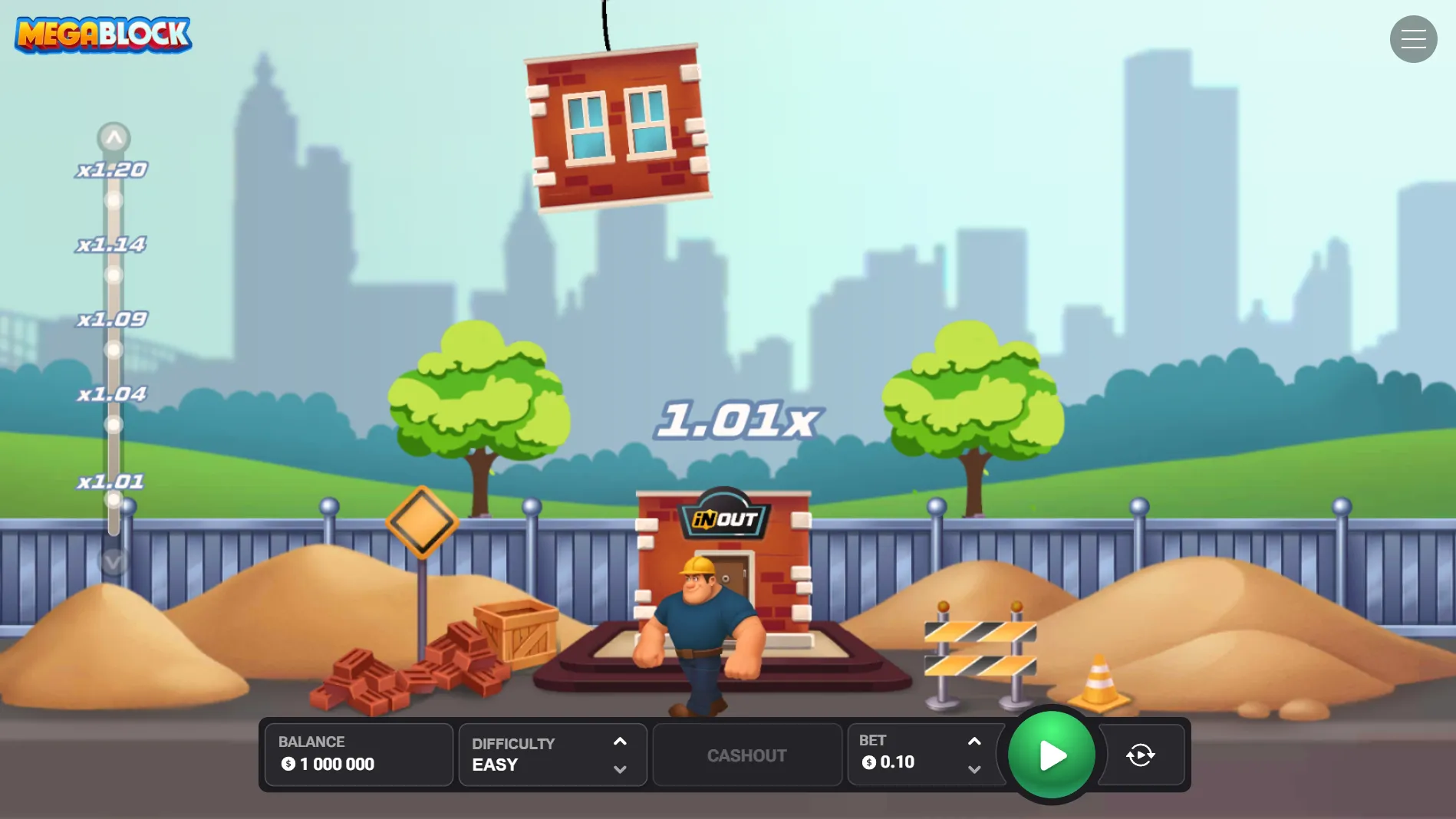
Inout's block-stacking title has a clean and focused interface, with all essential information visible at a glance. Familiarising yourself with each element before your first real-money round prevents confusion during play.
Interface Elements Explained
Tower Display (Centre of Screen)
The central visual element is the tower itself — a stack of blocks on a platform. As you successfully drop each block, the tower grows upward on screen. The swinging block travels above the tower's current height. On Easy mode the tower is widest; on Hardcore the tower is narrowest relative to the block's swing width, making alignment more demanding.
Multiplier Indicator (Top Right)
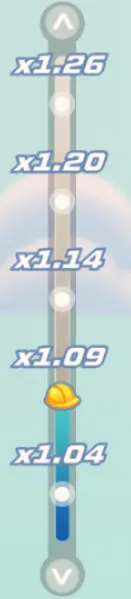
The current multiplier display shows what you would receive if you cashed out right now. It updates after each successful block. At the start of a round before any blocks land, the multiplier reads 0x or shows the starting value for the current difficulty level. Some interface versions also display a multiplier ladder showing the full sequence of multiplier values for your chosen difficulty.
Bet Amount Display (Bottom Left)
Shows your current bet for this round. Use the minus and plus buttons to adjust before starting. Once a round begins, the bet cannot be changed until the round ends.
Difficulty Selector (Below Bet Controls)
The four difficulty buttons (Easy, Medium, Hard, Hardcore) are accessible before the round starts. The currently selected difficulty is highlighted. On mobile, these may appear as a dropdown or horizontal scroll.
Drop Button (Centre Bottom)
The primary action button. Press this — or tap the screen on mobile — to drop the current block when you judge the timing is correct. On desktop, many players use the spacebar or enter key as an alternative to clicking the button.
Cash Out Button (Right Side)
Available between blocks after your first successful drop. Pressing Cash Out locks in your current multiplier and credits your winnings. The button typically displays your current payout amount (bet × current multiplier) to make the decision concrete.
Round History / Statistics Panel
Many implementations include a collapsible panel showing your recent round history — the difficulty chosen, final multiplier (or miss on block N), and outcome. This is useful for reviewing your cash-out patterns over a session and does not affect gameplay.
Settings Menu
Accessible via a gear icon, the settings menu controls sound volume, visual effects intensity, and — critically — the provably fair seed settings. This is where you can view your current server seed hash, change your client seed, and access historical round verification. See the Provably Fair section for full details.
Provably Fair System Explained
Mega Block uses a provably fair system to demonstrate that game outcomes are genuinely random and not manipulated in real-time by the operator. Understanding how this works gives you the ability to independently verify any round — an important safeguard when playing for real money.
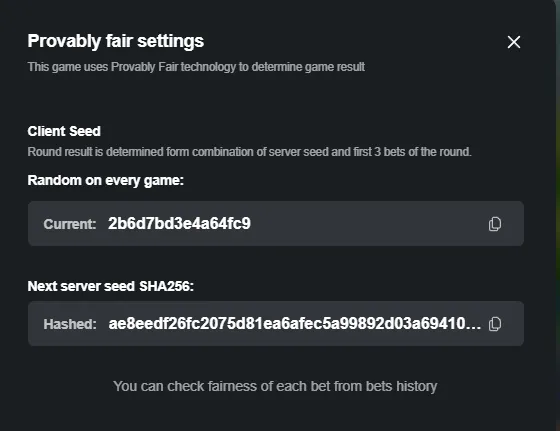
The Three Components
Every Mega Block round is determined by three cryptographic inputs:
- Server Seed: Generated by Inout Games' servers before the round begins. You are shown a SHA-256 hash of the server seed at the start of the round — you can verify the server could not have changed its seed after you placed your bet. The actual seed is only revealed to you after the round ends.
- Client Seed: A value you provide or that is randomly assigned to your session. You can change your client seed at any time between rounds in the settings menu. Because the client seed is partially under your control, the operator cannot target your specific session for manipulation — changing your seed would change all future outcomes.
- Nonce: A counter that increments by one with each round you play on a given server-client seed combination. The nonce ensures that even if you keep the same seeds, every round produces a unique outcome.
How to Verify a Round
After any completed round, you can verify the outcome was genuine:
- Open the settings or fairness menu in Mega Block.
- Select the round you want to verify (or use the current round).
- The full server seed (now revealed post-round) will be shown alongside the client seed and nonce used.
- Apply the SHA-256 hash algorithm to the server seed and confirm it matches the hash shown at the start of the round. Free SHA-256 calculators are available online.
- Combine the server seed, client seed, and nonce using the HMAC-SHA-256 algorithm documented in Inout Games' fairness specification. The resulting value, when mapped through the documented conversion function, produces the exact block placement sequence for that round.
This process proves two things: the server seed was committed before your bet was placed (verified by hash match), and the outcome was derived deterministically from the three inputs (verified by algorithm replication). If any tampering had occurred, the hash would not match and the algorithm would produce a different outcome.
Practical Implications
Most players will never manually verify a round — and that is fine. The value of provably fair is not that you must verify every round, but that you could. The system provides a credible check on operator behaviour that traditional casino games do not offer. When a casino claims their RNG is third-party audited, you must trust that auditor. With provably fair, you can verify directly.
Provably fair does not eliminate the house edge. The server seed still produces outcomes that, across millions of rounds, result in the mathematically expected 4.5% return to the house. What it prevents is the operator adjusting outcomes for specific players, on specific rounds, or in response to your betting patterns.
Game Rules and Bet Limits
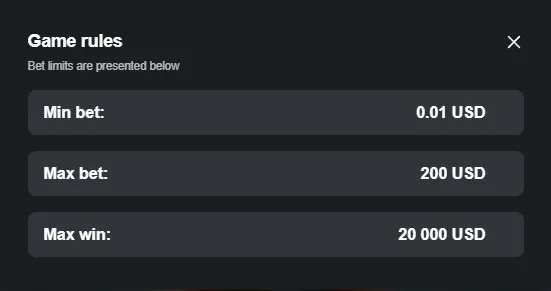
Official Bet Limits
Mega Block's published bet limits as set by Inout Games are:
- Minimum bet: €0.10 per round
- Maximum bet: €100 per round
- Currency: EUR (the game uses your casino account currency)
These are the game-level limits. Individual casinos may impose stricter limits — for example, reducing the maximum to €50 per round or raising the minimum to €0.50. Always check the limits shown within the game interface after launch, as they reflect the casino's specific configuration of Mega Block.
Core Rules Summary
- Rounds are individual — each round is independent of previous results. Prior block placements have no effect on the probability of future rounds.
- Difficulty must be chosen before a round starts and cannot be changed during play.
- Bet amount must be confirmed before pressing Play. It cannot be adjusted once the round is in progress.
- A round ends under one of three conditions: you miss a block (total loss of bet), you successfully place all blocks on your chosen difficulty (maximum multiplier achieved and paid), or you press Cash Out between blocks.
- Cash-out is instantaneous. There is no processing delay between pressing Cash Out and the winnings being credited.
- In the event of a disconnection during an active round, Mega Block's session recovery feature automatically resumes the round when you reconnect. The round outcome is preserved exactly as it was at the point of disconnection.
- The RTP of 95.5% applies across all difficulty levels and is calculated over millions of rounds, not per session.
- No bet can be placed above the maximum win per round. If a bet multiplied by the maximum multiplier for the chosen difficulty would exceed the casino's maximum payout, the casino may limit the applicable bet size accordingly.
Session Recovery
Mega Block includes automatic session recovery. If your connection drops while a round is active — whether due to browser crash, loss of internet connection, or accidental page close — you can return to the game and it will restore your round to the exact state it was in. Your bet remains active, your tower progress is preserved, and you can continue the round from where you left off. This prevents the loss of a bet due to technical failures outside your control.
Auto-Game and Advanced Features
Auto-Game Mode
Mega Block includes an auto-game feature that allows the game to play rounds automatically without requiring you to manually time each block drop. This is useful for players who want to run a high volume of rounds at a consistent bet size and difficulty, or who want to observe how the game behaves at specific settings over many rounds.
To activate auto-game, look for the "Auto" button in the game's control panel — typically located near the Play button. Before starting, you configure:
- Number of rounds: Set a fixed number of rounds for auto-game to run (e.g., 50 rounds). Auto-game stops when this count is reached.
- Stop on win of: Enter a cumulative profit amount. Auto-game stops if your balance increases by this amount during the auto session.
- Stop on loss of: Enter a maximum loss amount. Auto-game stops if your balance decreases by this amount. This is the most important limit — it acts as an automatic session loss cap.
- Auto cash-out at: Set a multiplier at which auto-game will automatically cash out each round. For example, setting 3x means auto-game cashes out whenever you reach 3x — it does not attempt further blocks. If you miss before reaching 3x, the round ends with a loss as normal.
During auto-game, the timing of block drops is handled by the game's internal algorithm. The algorithm aims for correct placement on each block, but the mechanics of auto-game timing are not identical to manual play — the auto-game mode is effectively using the same provably fair seed inputs to determine outcomes, with the game engine resolving drops according to the difficulty's timing parameters.
When Auto-Game Is Useful
Auto-game is genuinely useful for specific purposes: observing the game's variance over many rounds at low stakes, running a strategy test, or playing a session with pre-set limits that enforce responsible play parameters automatically. The stop-on-loss setting in particular functions as a mechanical loss limit — it removes the temptation to override a decision you made in a calmer moment.
Auto-game is not a profit-generating tool. Automating play does not change the underlying 95.5% RTP or the 4.5% house edge. Over a long auto-game session, the expected mathematical outcome is the same as the same number of manual rounds.
Session Statistics
Mega Block's interface provides a session statistics overlay that tracks your performance across rounds in the current session. Metrics typically include: rounds played, rounds won (at least one block placed successfully before cash-out), total amount wagered, total returned, and current net position. This data helps you assess whether you are ahead or behind your starting balance at any point, which informs decisions about extending or ending a session.
Sound and Visual Settings
The settings menu provides control over sound effects, background music, and animation intensity. Lower animation settings can improve performance on older mobile devices. On mobile, turning off audio may also reduce battery consumption during longer sessions. These settings persist between sessions on the same device through browser local storage.
Tips for Beginners: Practical, Honest Advice
These tips are based on how Mega Block actually works — not on strategies that promise results they cannot deliver. The game has a 4.5% house edge, which means the expected long-term outcome is a net loss. The goal of these tips is to help you play in a way that manages that reality sensibly.
1. Start on Demo Mode, Not Real Money
Mega Block's timing mechanic feels different in practice from how it reads in a description. Before placing a single real-money bet, spend at least 30–50 rounds in demo mode on Easy difficulty. Your goal is to develop an intuitive feel for the pendulum rhythm and identify your consistent timing instincts. Demo mode is free and offers identical mechanics to real-money play.
2. Stay on Easy Until You Can Consistently Reach Block 10+
There is no prize for progressing to higher difficulties quickly. Before moving from Easy to Medium, you should be landing 10 or more blocks consistently in demo play — not occasionally, but most rounds. If you are regularly missing on blocks 3 to 6, you do not yet have reliable timing calibration. Higher difficulties on poor timing skill will drain a bankroll very quickly.
3. Set a Cash-Out Target Before Every Round
Decide your target multiplier before you press Play, not while you are watching the multiplier climb. In the moment, with your multiplier sitting at 5x and climbing, the temptation to keep going is strong regardless of rational analysis. Pre-committing to a target — say, "I will always cash out at 4x on Easy" — removes that in-the-moment pressure. You can use the auto cash-out feature to enforce this mechanically. For more structured approaches, see our strategies guide.
4. Size Bets to Your Actual Bankroll, Not Your Ambitions
A €50 session budget used for €5 bets gives you only 10 rounds before you could be bust. The same €50 at €0.50 bets gives you 100 rounds of play. More rounds means more time for your timing skill to express itself and less dependence on a single round going well. At 1% of bankroll per bet, a €50 budget gives you €0.50 bets and a genuine 100-round session floor — even if every round ends in a miss.
5. Treat Lost Rounds as the Cost of Playing, Not as Recoverable Debts
Every time you miss a block and lose your bet, you will feel the pull to increase your next bet to win it back. This impulse — chasing losses — is the fastest route to depleting a session bankroll. Mega Block's outcomes are independent across rounds. A loss on round 20 has zero effect on the probability of winning round 21. Raise bets only when your overall balance is ahead of your starting point, not when you are trying to recover from a losing run.
6. Use the Loss Limit in Auto-Game as a Safety Net
If you choose to use auto-game, always set a stop-on-loss amount before starting. A reasonable figure is 20–30% of your session bankroll. If auto-game triggers the stop-loss, that is the session over — do not deactivate auto-game and continue playing manually to chase the loss back. The stop-loss limit only works as a protection if you respect it.
7. Do Not Attribute Patterns to Random Outcomes
Mega Block rounds are independent events. After a string of misses on block two, block two is no more or less likely to succeed on the next round than it was on any previous round. After a string of successful runs, the game is not "due for a miss". The provably fair system generates each outcome fresh from seed inputs that do not carry memory of previous results. Decisions based on perceived streaks or "hot" sequences are not grounded in how the game functions.
Common Mistakes to Avoid in Mega Block
These are the errors most frequently made by players new to Mega Block — and, in some cases, by experienced players who have developed bad habits. Avoiding them will not overcome the house edge, but it will prevent you from losing more than you should.
Jumping Straight to Hard or Hardcore Mode
The most common mistake new players make is selecting Hard or Hardcore mode from their first session, attracted by the large multiplier numbers. The timing tolerance on these difficulties is narrow, and without the timing intuition that develops through Easy and Medium play, you will miss on the first or second block round after round. The effective cost per round is identical regardless of difficulty — what changes is how often a round ends on block one versus block ten.
Ignoring the Cash-Out Option in Favour of Always Going Longer
Mega Block's design creates a pull toward continuing — the multiplier ladder keeps showing you what you could win if you just land one more block. Players who consistently decline to cash out, always targeting the maximum, will find that the house edge applies with full force over any significant number of rounds. Cashing out at 2x after five blocks means a profit. Chasing the maximum on every round produces frequent total losses.
Playing Without a Session Budget
Loading money onto a casino account without a clear session budget is a structural mistake. Determine before you start how much of your casino balance is allocated to this Mega Block session, and treat that amount as the only funds available. When it is gone, the session is over — regardless of whether that happens in 20 rounds or 200.
Using Maximum Bet from the Start of a Session
Beginning a session with €100 bets when your balance is €200 means you can lose your entire session budget in two rounds. High bet sizes are only sustainable relative to a large bankroll. Starting with smaller bets preserves your ability to keep playing, recover from early variance, and make strategic decisions from a position of balance rather than desperation.
Assuming the Demo Plays Easier Than Real-Money Mode
This is a persistent myth across crash-style games. The crash game's demo and real-money modes use identical game engines and the same provably fair framework. The demo does not have more generous timing windows or more favourable seed sequences. If you are performing well in demo and poorly in real-money, the most likely explanation is session anxiety affecting your timing precision, not a difference in the underlying game.
Not Verifying the Game Rules Before Playing at a New Casino
Casinos can configure Mega Block with different bet limits than Inout Games' defaults. A casino might raise the minimum bet or lower the maximum. Always open the in-game rules panel (the information icon) after loading Mega Block at a new casino to confirm the specific limits apply to your session.
Playing Under Time Pressure or While Distracted
Mega Block's core mechanic is timing. Anything that degrades your attention to the pendulum's position — a television in the background, a phone notification, physical tiredness, or self-imposed time pressure to "fit in a few rounds" — directly reduces your timing accuracy. Poor timing means more missed blocks, which means more round losses. Play when you can give the game full attention, or use auto-game mode with pre-set limits if you cannot.
Changelog
This guide is maintained and updated as Mega Block evolves. Below is a record of substantive changes to this page.
Frequently Asked Questions
How do you drop a block in Mega Block?
Press the Drop button — or tap the centre of the screen on mobile — at the exact moment the swinging block is positioned directly above the tower. The block follows a pendulum arc and passes overhead once per swing. If the block's centre falls outside the tower's edges at the moment of release, it misses and the round ends. On desktop, the spacebar or enter key also functions as a Drop command in most implementations. The key is to watch the block's position relative to the tower rather than the speed of movement, which remains consistent throughout the round.
Which difficulty level should beginners start with in Mega Block?
Beginners should always start with Easy mode. It offers 24 blocks, the widest timing tolerance, and a gentle multiplier curve from 1.01x to 23.75x. This gives you the most opportunities per round to practise timing and develop the rhythm of the pendulum mechanic before the more punishing timing windows of Medium, Hard, and Hardcore. Use the free demo on Easy mode for at least 30–50 rounds before placing real-money bets, and only progress to Medium when you can consistently land 10+ blocks per round in demo play.
Can you change the difficulty level during a round?
No. Difficulty must be selected before each round begins. Once you press Play and the round is active, the difficulty is locked for that round. You cannot switch from Easy to Medium mid-round, nor can you adjust the difficulty to a lower level if you are struggling with a particular drop. To change difficulty, you must either cash out at your current multiplier or wait for the round to end (through a miss or completing all blocks). The new difficulty then applies from the next round onward.
What happens if you miss a block in Mega Block?
If you drop the block and it does not land on the tower — because you timed the drop when the block was not centred over the tower — the round ends immediately and your bet for that round is lost. There is no partial payout based on how many blocks you successfully placed before missing. The only way to secure a return from any given round is to cash out before missing. This is why the cash-out decision is central to Mega Block strategy: once you miss, the entire bet is gone regardless of how high your multiplier had climbed before that point.
Is there a way to verify Mega Block rounds are fair?
Yes. Mega Block uses a provably fair system. Each round's outcome is pre-determined by three inputs: a server seed (whose SHA-256 hash is shown to you before the round), your client seed, and a nonce that increments with each round. After the round ends, the full server seed is revealed. You can hash it independently and confirm it matches the hash shown before play — proving the server could not have changed its commitment after you placed your bet. You can then replicate the full outcome calculation using HMAC-SHA-256 with the published algorithm to confirm the round played exactly as determined. The provably fair settings are accessible through the settings or fairness menu within the game.
How does Mega Block auto-game mode work?
Auto-game mode allows Mega Block to run rounds automatically at your pre-set bet amount and difficulty level. You configure: the number of rounds to play, an optional stop-on-win amount, a stop-on-loss amount, and an optional auto cash-out multiplier (which instructs the game to cash out whenever it reaches a specific multiplier). Once started, the game handles block timing automatically without your manual input. Auto-game stops when any of your configured limits are reached. The stop-on-loss setting functions as an automatic session loss cap — set it before starting any auto session. Auto-game does not change the underlying RTP or house edge.
What is the minimum and maximum bet in Mega Block?
Inout Games sets the standard bet limits for Mega Block at a minimum of €0.10 and a maximum of €100 per round. These limits apply across all four difficulty levels. However, individual casinos can configure Mega Block with different limits — some may restrict the maximum to a lower figure, and some may set a higher minimum. Always check the bet limits displayed in the game interface after loading Mega Block at any specific casino, as the casino-level configuration takes precedence over Inout Games' defaults.
Does Mega Block work on mobile without installing an app?
Yes. Mega Block is built in HTML5 and runs entirely in your mobile browser — no download, no app installation, and no browser plugin required. It works on both Android and iOS devices in Chrome, Safari, Firefox, and most major mobile browsers. The game is optimised for touch input, with the Drop button and Cash Out controls sized and positioned for comfortable thumb use. It supports both portrait and landscape orientations. Load times on a standard 4G or Wi-Fi connection are typically under five seconds. Some partner casinos also offer dedicated mobile apps that include Mega Block — see our download guide for details.