
Mega Block Game Strategies: Mathematical Analysis & Tested Tactics 2026
A data-driven breakdown of optimal play across all four difficulty levels. Covers bankroll management, cashout timing, and the mathematics behind the 95.5% RTP.

Understanding the Mathematics
Before discussing any tactical approach, it is essential to understand the mathematical framework governing every Mega Block round. If you are not yet familiar with the core mechanics, read our how to play guide first. Without this foundation, strategies become guesswork.
RTP, House Edge, and Expected Value
Mega Block, developed by Inout Games, carries a published Return to Player (RTP) of 95.5% and a house edge of 4.5%. These figures are two ways of expressing the same mathematical reality: for every €100 wagered over a statistically significant number of rounds, the game returns an average of €95.50 to players and retains €4.50 for the operator. To understand how these numbers compare to similar titles, see our Mega Block vs Tower Rush comparison for a full feature breakdown.
In practical terms, this is straightforward. If you begin a session with a €200 bankroll and wager the entire amount across many small bets, the expected outcome is a loss of approximately €9. This is the cost of playing — it does not mean you will lose exactly that amount in any single session, because variance plays a significant role in shorter time frames. You could end a session up €50 or down €80 and both outcomes remain consistent with a 95.5% RTP game.
Expected value per bet is calculated as:
EV = (Stake × RTP) − Stake = Stake × (0.955 − 1) = Stake × −0.045
On a €10 bet, your expected value is −€0.45. This does not mean you lose 45 pence every round; it means that averaged across thousands of rounds, your average loss per €10 bet trends toward 45 pence.
Probability at Each Block Level
Successfully placing each additional block follows an inverse probability relationship with the multiplier. As a general approximation, the chance of reaching multiplier X is roughly proportional to 1/X, adjusted for the house edge. On Easy mode, reaching a 2x multiplier is a relatively common event. Reaching the maximum 23.75x requires successfully placing every single block in the sequence — an outcome with a correspondingly low probability.
Variance and Its Effect on Sessions
Higher difficulty modes produce higher variance. This means the range of possible outcomes per session is wider. On Easy mode, you might complete 100 rounds and find your bankroll has shifted by ±15%. On Hardcore mode, 100 rounds could leave you with double your starting bankroll or with very little remaining — both outcomes are entirely plausible within normal variance.
Variance is not the enemy; misunderstanding it is. Many players on a bad Hardcore streak conclude that something is wrong with the game, increase their bets to recover losses, and deplete their bankroll rapidly. The correct interpretation is that high variance modes produce exactly this kind of clustered loss period, and the only rational response is pre-planned bankroll limits enforced before the session begins.
The key insight: the house edge is fixed at 4.5% regardless of which mode you play. Difficulty level selection changes your variance profile, not your expected loss rate per pound wagered.
Easy Mode Strategy: Conservative Cashouts for Bankroll Preservation
Easy mode operates with 24 blocks and multipliers scaling from 1.01x to 23.75x. The wider target zone for each block placement means individual rounds have a higher success rate compared to other difficulty levels. This translates to more frequent wins but smaller multiplier values at any given block count.
Recommended Target Range: 1.5x to 3x
For conservative play on Easy mode, targeting cashouts between 1.5x and 3x is a widely used approach. The rationale is that these multipliers represent early-to-mid tower levels where block placement success rates are at their highest. You accept a lower reward in exchange for a higher probability of actually collecting it.
Consider the arithmetic: if you target 2x on Easy mode and your win rate for reaching that level is approximately 45%, you are winning €2 on roughly 45 out of every 100 rounds and losing your stake on 55. With a €5 stake:
- 45 wins × €5 profit = €225 returned
- 55 losses × €5 stake = €275 lost
- Net: −€50 over 100 rounds
This aligns with the expected value calculation for a 95.5% RTP game over a €500 total wager (100 × €5 = €500, expected loss = €22.50 — the specific figures vary by actual probability, but the direction is consistent).
Easy Mode Bankroll Sizing
For Easy mode play at a €5 stake, a session bankroll of €100-€150 provides sufficient depth to ride out normal variance. At 1% of bankroll per bet, a €100 bankroll supports €1 stakes, giving you 100 rounds of runway before reaching a total loss — which is statistically very unlikely at Easy mode volatility levels.
Who Easy Mode is For
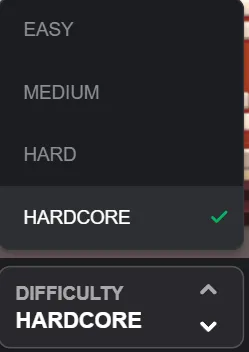
Easy mode suits players who are new to Mega Block, players testing a new cashout strategy in the free demo before committing to higher stakes, and players who prefer longer sessions with steadier action. If you have not yet opened an account, our registration guide walks you through the process step by step. The lower multiplier ceiling means large single-round wins are not on the table, but neither are the devastating quick-fire losses that Hardcore mode produces.
Medium Mode Strategy: The Balanced Approach
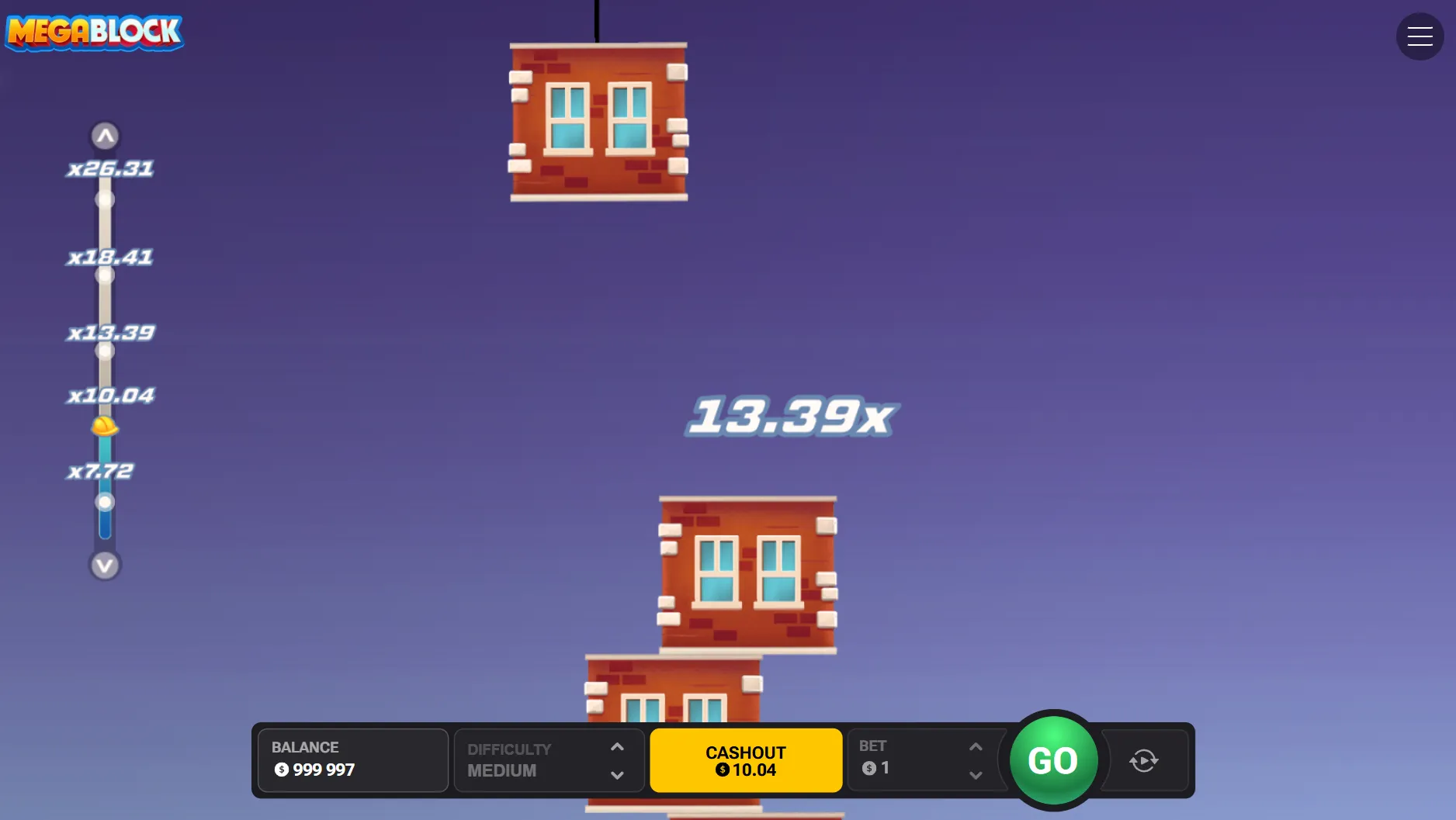
Medium mode reduces the block count to 22 and dramatically expands the multiplier ceiling to 2,116x. This is the mode where the risk-reward trade-off becomes genuinely interesting. You have access to multipliers that can meaningfully change a session's outcome, while the block count remains high enough that reaching moderate targets is achievable within normal variance.
Target Range: 3x to 10x
The 3x-10x zone on Medium mode represents what many experienced players consider the optimal risk-reward corridor for this difficulty level. These multipliers require placing enough blocks that the swinging pendulum mechanic genuinely tests your timing, but they do not require perfect execution of an entire 22-block run.
A 5x target on Medium mode is achievable with consistent timing and provides a meaningful return. If your win rate for reaching 5x is approximately 18-20% (estimated, as actual probabilities are determined by the provably fair algorithm), a €10 stake strategy looks like this:
- 19 wins out of 100 rounds × €40 profit (5x minus stake) = €760
- 81 losses × €10 = €810 lost
- Net: −€50 over 100 rounds on €1,000 total wagered
Again, this aligns with the expected 4.5% house edge (4.5% of €1,000 = €45).
Stake Reduction on Medium
Because Medium mode produces longer losing streaks than Easy mode, reduce your per-round stake when moving up from Easy. If you played Easy at 2% of your session bankroll, move Medium play to 1% or 1.5%. The additional variance requires more bankroll depth to survive the inevitable losing runs between wins.
Session Length Considerations
On Medium mode, 50-75 rounds is a reasonable session length for a single sitting. Beyond this, decision fatigue can affect your timing and you risk making emotional bets. Set a round limit before you begin and honour it, regardless of whether you are up or down at that point.
Hard Mode Strategy: High Risk, Smaller Stakes
Hard mode operates with 20 blocks and a maximum multiplier of 48,348x. The swing of each pendulum block is faster and less forgiving. Missed placements occur more frequently, and consecutive losses are a normal feature of any Hard mode session — not a sign of bad luck. This mode demands strict bankroll discipline because variance is high enough that short sessions can appear to produce wildly different results.
The Core Principle: Smaller Bets, More Rounds
The most important adjustment when moving to Hard mode is reducing your bet size relative to your bankroll. A losing run of 10-15 consecutive rounds is within normal variance for Hard mode. If you are betting 5% of your bankroll per round, 15 consecutive losses wipes out 75% of your session funds before a single win can recover them. Betting 0.5-1% of your bankroll per round means the same 15-round losing streak costs you 7.5-15% — uncomfortable but survivable.
Multiplier Targeting on Hard Mode
Most players on Hard mode should resist the temptation to chase the high-end multipliers above 500x in every round. A more measured approach is to set a consistent target in the 10x-50x range, where you have a realistic chance of success across multiple rounds, and treat any larger wins as a bonus rather than the plan.
If you have an established bankroll and want to target higher Hard mode multipliers, the correct approach is to dedicate a small, fixed percentage of your session stake to "long-shot" rounds — capping these at no more than 5 rounds per session to prevent large losses while still giving yourself exposure to the bigger payouts.
Hard Mode and Timing Skill
Unlike Easy mode where timing windows are comparatively generous, Hard mode's faster pendulum swings make consistent timing noticeably more difficult. Practise on the free demo before wagering real money on Hard mode. Poor timing on Hard mode is a bankroll drain that sits on top of the house edge — compounding your losses in a way that cannot be overcome by any strategy.
Hardcore Mode Strategy: Accept the Loss Rate
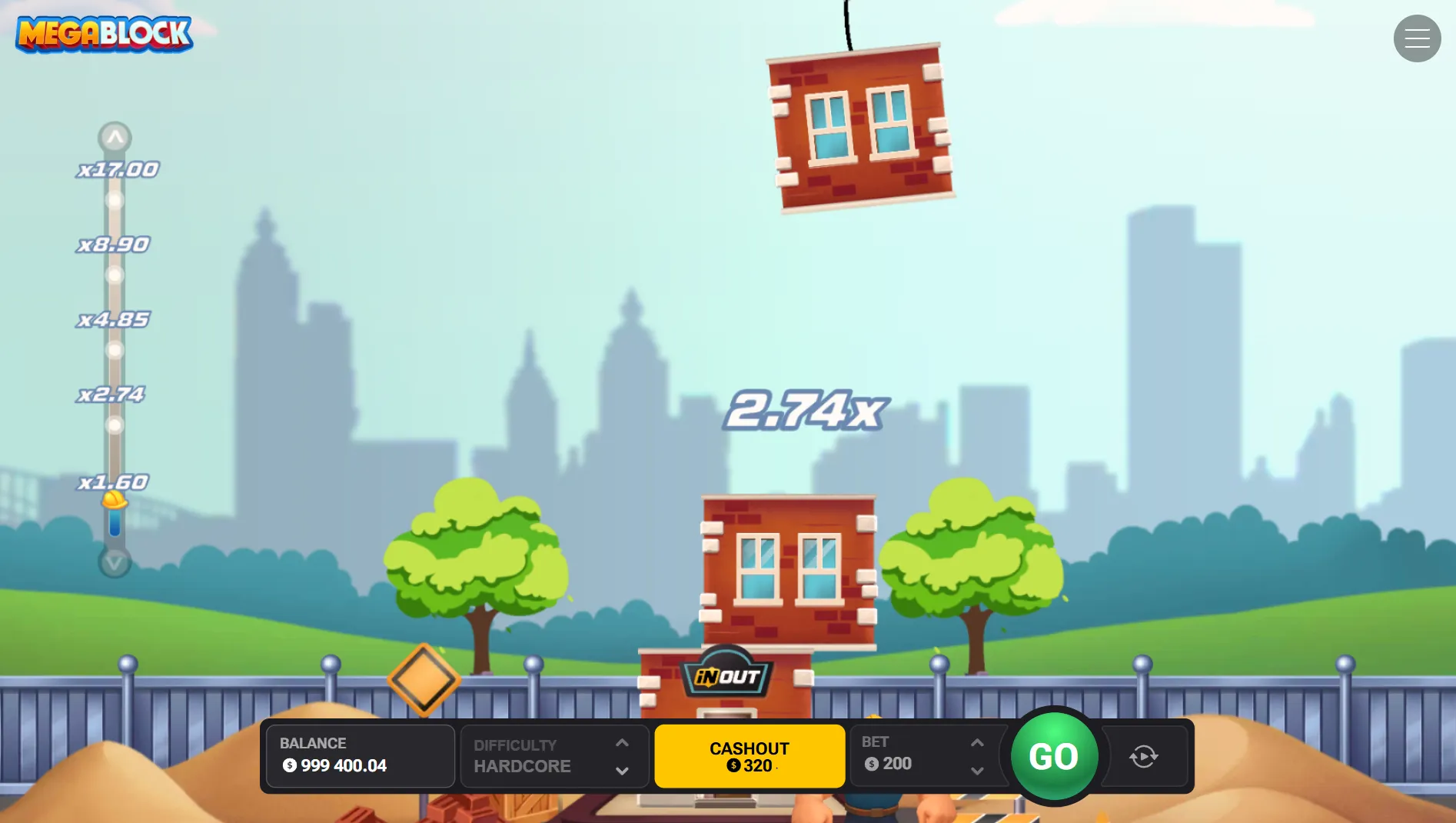
Hardcore mode is the highest-variance offering in this tower-building crash game, with 15 blocks and a maximum multiplier of 2,941,884x. The block count reduction means each missed placement eliminates a larger proportion of the potential multiplier sequence. Most rounds end early. This is expected behaviour, not a malfunction.
The Mathematics of Hardcore
With only 15 blocks and the game's fastest pendulum swing, the probability of reaching even moderate multipliers (10x-20x) is substantially lower than on other difficulty levels. Players choosing Hardcore mode must accept that they will lose the majority of their rounds. The strategy is not to reduce losses per round — it is to ensure that when the rare large multiplier does land, it covers the accumulated cost of the losing rounds that preceded it.
A working example: at a €1 stake on Hardcore mode, you might budget for 200 losing rounds (€200 total losses) with the aim of landing one or two significant multipliers in that window. A single 500x win on a €1 bet returns €500, covering 500 previous €1 losses. The probability of hitting 500x must be weighed against the cost of rounds played to reach it.
Minimum Bet Sizing is Essential
Hardcore mode should only be played at the minimum viable bet size given your bankroll. The game's minimum bet of €0.10 exists for a reason — it allows players to absorb the high loss frequency without catastrophic bankroll damage. Playing Hardcore at large stakes is not a valid strategy; it is an accelerated version of the losing experience that variance will eventually deliver regardless of round outcomes.
Hardcore Mode Session Limits
Set a hard cap of 30-40 rounds per Hardcore session. The emotional experience of repeated consecutive losses — which is mathematically expected in this mode — creates pressure to increase bets and "recover" the losses. Shorter sessions prevent this psychological trap from taking hold. If your 30-round session ends in profit, stop. If it ends in a planned loss within your pre-set limit, stop. Either way, the session is over.
Bankroll Management: The Foundation of Responsible Play
Effective bankroll management is the single most impactful factor in how long your session lasts and how much control you maintain over your gambling. It does not improve your odds or overcome the house edge — nothing does — but it determines whether you can absorb variance without catastrophic loss and make rational decisions throughout a session.
The 1-2% Rule
The foundational bankroll management principle is to risk no more than 1-2% of your total session bankroll on any single round. If you start a session with €100, your maximum bet per round is €1-€2. This might feel conservative, but the mathematics justify it clearly: to lose your entire €100 session bankroll at €1 per round, you would need to lose every single round — an event that approaches impossibility on Easy mode and remains highly unlikely even on Hardcore mode within a reasonable session length.
The 1-2% rule also prevents a specific psychological trap: the bet escalation that follows a losing streak. When you are down €30 on a €100 bankroll and you feel compelled to bet €20 to "get it back quickly," you are abandoning rational play. Pre-set bet sizes remove this temptation because the numbers are decided before emotions are engaged.
Session Loss Limits
Establish a session loss limit before you deposit or access your casino balance. A common benchmark is 20-25% of your session bankroll. If you arrive with €100 and lose €20-€25, the session ends — regardless of how you feel about the losses, how close a recent win seemed, or what your "gut" tells you about the next round.
Loss limits work only if they are absolute. "I will stop if I lose 25%, unless I feel like I am due a win" is not a loss limit — it is a suggestion you will ignore when it matters. Write the number down before you start if that helps you commit to it.
Win Targets
Win targets are less universally agreed upon than loss limits, but they serve a specific purpose: preventing greed from converting a winning session into a losing one. A reasonable win target is 50% profit on your session bankroll. If you start with €100 and reach €150, consider stopping or at minimum banking the original €100 and playing only with the €50 profit.
Continuing to play after reaching a win target is not inherently wrong — but do so with clear awareness that you are extending your exposure to the house edge. Every additional round increases the expected loss by 4.5% of whatever you wager. The longer you play, the more likely the session average converges toward the mathematical expectation.
Separate Stakes from Winnings
A practical bankroll management technique is to mentally or physically separate your original stake from any winnings accumulated during a session. If you start with €50 and build it to €80, treat the original €50 as your "protected" bankroll and the €30 as the "play" portion. Only risk the play portion after that point. This ensures you leave the session with at least your original stake, even if variance turns against you.
Bankroll Management Summary
- Bet no more than 1-2% of your session bankroll per round
- Set a session loss limit of 20-25% before you begin — make it absolute
- Consider a win target of 50% profit as your "review point"
- Track your session balance, not just wins and losses
- Separate original stake from winnings once in profit
- Never use funds needed for bills, rent, or essential expenses
- Check available casino bonuses to extend your session bankroll before depositing
When to Cash Out: Risk and Reward Analysis
The cashout decision is the central skill in Mega Block. Unlike many casino games where outcomes are entirely random and the player has no input beyond initial bet sizing, the crash game gives you a choice at every block level: collect your current multiplier or risk another placement. Understanding how to approach this decision is central to any coherent playing strategy.
The Sunk Cost Fallacy
By far the most common cashout error is holding on because you "have already come this far." If you are at 5x on Medium mode and debating whether to attempt block 12, the fact that you successfully placed blocks 1-11 is irrelevant to block 12's probability of success. Each block placement is an independent event. The probability of success on block 12 is exactly what it always was — it is not higher because you have been playing well, and it is not lower because you are "due" a miss.
Cash out when the expected value of the next placement falls below your comfort level — not when you feel you have "earned" the right to continue, and not when you feel "on a roll."
Pre-Set Cashout Targets
A more disciplined approach is to decide your cashout target before the round begins and commit to it unconditionally. If you have decided to cash out at 4x, exit at 4x even if the blocks look perfectly aligned and you feel confident about the next placement. Pre-commitment removes the in-round pressure that leads to greed-driven decisions.
Example cashout frameworks by mode:
- Easy mode: Pre-set at 2x or 2.5x. Collect without exception.
- Medium mode: Pre-set at 5x. Allow yourself a secondary trigger at 10x only if you started the session with a specific "long-shot" allocation.
- Hard mode: Pre-set at 15x-25x depending on session objectives.
- Hardcore mode: Pre-set at 50x. Resist the pull of higher targets until you have substantial unrealised profit in the round.
Ladder Cashout Approach
Some players use a "ladder" method: cash out a portion of the round's winnings at each milestone and let the remainder ride. Mega Block does not natively support partial cashouts — you exit the entire bet at once. This means the ladder approach must be simulated across separate rounds, varying your cashout target systematically rather than within a single round. For example: round 1 targets 2x, round 2 targets 5x, round 3 targets 10x, and you evaluate results across the three-round cycle rather than optimising a single round.
Reading the Pendulum
Timing accuracy directly affects your success rate, which in turn affects when it makes sense to push for higher multipliers. If you are having a session with poor timing — perhaps tired, distracted, or playing on a device with input lag — lower your cashout targets proportionally. For the best mobile experience, download the dedicated Mega Block app to reduce latency compared to browser play. Chasing a 20x on Hard mode with degraded timing is a losing proposition even before the house edge is considered.
The Martingale Trap: Why Doubling After Losses Fails
Martingale instructs players to double their bet after every loss, with the theory that a single win will recover all previous losses and produce a net profit equal to the original stake. It is one of the oldest and most widely misunderstood betting systems in gambling, and it does not work against a house edge — including Mega Block's 4.5%.
How Martingale Appears to Work
Its superficial appeal is undeniable. If you bet €1, lose, bet €2, lose, bet €4, lose, bet €8, and win — you recover €8 on a total outlay of €15 (€1+€2+€4+€8), for a net profit of €1. After any number of consecutive losses, the first win puts you ahead by your original €1 stake. On paper this seems impossible to lose.
Why It Fails in Practice
Martingale fails in practice for two interconnected reasons:
- Exponential bet escalation: After just 10 consecutive losses starting at €1, the next required bet is €1,024. After 13 losses, the required bet exceeds Mega Block's €100 maximum. At that point, the system literally cannot be continued. You have lost €8,191 (€1+€2+€4+...+€4,096) and cannot place the recovery bet.
- The house edge applies to every bet: Every individual bet in the Martingale sequence carries the 4.5% expected loss. The system does not change the probability of any single round. It rearranges your bankroll exposure — concentrating large sums into individual rounds where a single loss at high stakes can be devastating.
The Streak Probability Reality
Those who dismiss the Martingale's limitations typically underestimate how often long losing streaks occur. In a game with approximately 50% win rate per round (an illustrative figure — actual rates vary by difficulty and target), the probability of 10 consecutive losses is (0.5)^10 ≈ 0.1%. This sounds rare, but across 1,000 rounds, you can statistically expect such a streak to occur approximately once. With more realistic win rates on Medium or Hard mode, streaks of 10-15 losses are considerably more common.
What to Do Instead
Fixed stake betting — the same amount every round regardless of previous outcomes — is mathematically superior to Martingale because it limits maximum loss, keeps bet sizes within your bankroll management plan, and removes the emotional component of chasing losses. It does not overcome the house edge, but neither does Martingale — and fixed stakes does not carry the catastrophic downside risk that Martingale does.
Auto-Cashout vs Manual Play: Pros and Cons
This instant-win game allows players to set an automatic cashout at a predetermined multiplier, removing the need for manual timing. This choice has meaningful strategic implications beyond mere convenience.
Auto-Cashout: The Disciplined Option
Auto-cashout enforces your pre-session strategy without requiring active decision-making during the round. Once set, the game collects your winnings automatically when the target multiplier is reached, regardless of how you feel in the moment. This eliminates several categories of emotional error:
- Greed escalation: Seeing a 5x target approaching and deciding in the moment to push for 8x instead.
- Panic exits: Cashing out at 1.5x when your strategy called for 4x because the last three rounds ended early.
- Fatigue errors: Missing the optimal cashout window during longer sessions due to reduced reaction speed.
Auto-cashout is particularly well-suited to Easy and Medium modes, where a fixed moderate target is a sound strategic choice and the primary risk is emotional deviation from the plan.
Manual Play: The Active Option
Manual play allows you to respond to what is unfolding on screen in real time. An experienced player with well-calibrated timing might use manual play to exit earlier than their target if the pendulum pattern suggests an increased risk of a miss, or to push slightly beyond their target if a round is going exceptionally well.
Where manual play falls short is that the information suggesting "this round is going well" is largely illusory. Mega Block's provably fair system generates outcomes independently each round. Past block placements within a round do not meaningfully change the probability of the next placement succeeding beyond what the difficulty level sets. An experienced player may have better timing, but they do not have better information about future block probabilities than the algorithm does.
The Hybrid Approach
Some players use a hybrid: auto-cashout set at a conservative base target (e.g. 3x on Medium), combined with manual monitoring. If the round reaches the auto-cashout target, the system exits automatically. If for any reason the player wants to cancel the auto-cashout and exit earlier, they can do so. This provides the floor protection of auto-cashout while retaining the ability to exit early in unusual circumstances.
Recommendation
For most players, auto-cashout at a pre-determined multiplier produces more consistent results than manual play. The primary advantage of manual play — timing skill — is real, but is frequently outweighed by the emotional decision errors that in-play pressure introduces. Use manual play only if you have practised extensively on the free demo and have an established record of disciplined execution.
Common Mistakes to Avoid
These are the most frequently observed errors among players of Inout's block-stacking title. Each is predictable, each is avoidable, and each directly accelerates bankroll depletion beyond what the house edge alone would produce.
1. Chasing Losses
Chasing losses means increasing your bet size after a losing run to recover previous losses more quickly. It is the single most damaging behaviour in crash game play. As discussed in the Martingale section, increased bet sizes expose more capital to the house edge per round. A losing streak does not increase the probability of a win on the next round. Chasing losses is mathematically guaranteed to accelerate losses and has no offsetting benefit.
2. Ignoring Pre-Set Limits
Setting a loss limit and then overriding it — "just one more round" — converts a disciplined strategy into no strategy at all. The limit is only useful if it is enforced absolutely. If you find yourself regularly breaking your own limits, consider using the responsible gaming tools available at your casino: deposit limits, session time limits, and self-exclusion options. These tools enforce limits at the account level, removing the in-session temptation to override them. If you feel gambling is becoming a problem, organisations such as Gambling Therapy offer free, confidential support.
3. Playing the Wrong Difficulty Level
Selecting a difficulty level based on the appeal of large multipliers rather than your bankroll, risk tolerance, and timing skill is a common route to rapid loss. Hardcore mode's 2,941,884x maximum win is eye-catching — but if your session bankroll is €50 and you have limited timing experience, Hardcore mode will deplete it well before any substantial win is likely. Match your difficulty selection to your bankroll depth and demonstrated timing ability.
4. Failing to Account for Timing Skill Variance
Your timing performance is not constant across all playing conditions. Fatigue, distraction, device responsiveness, and connection quality all affect how accurately you can place blocks. Failing to adjust your strategy for these factors — by lowering your targets or bet sizes when conditions are suboptimal — is a systematic error that compounds the house edge with avoidable skill degradation.
5. Treating Wins as Skill and Losses as Bad Luck
A successful session on Mega Block may result from good timing, good strategy, or random variance in your favour. A losing session may result from poor execution, poor strategy, or random variance against you. Attributing all wins to skill and all losses to bad luck creates a distorted picture of your actual edge and encourages overconfidence that leads to higher stakes and larger eventual losses. Evaluate your performance over 50+ rounds, not 5.
6. Playing Without a Session Budget
Arriving at Mega Block without a clearly defined session budget is playing without a safety net. Define your session amount before you open the game: how much you are prepared to lose, how long you intend to play, and what win target would end the session early. Without these parameters, sessions expand indefinitely and losses compound.
7. Skipping the Demo
Mega Block offers a free demo mode with identical mechanics to the real-money game. Not using it before playing with real funds — especially before moving to a new difficulty level — is a straightforwardly avoidable mistake. The demo exists precisely so players can calibrate their timing, test their cashout strategy, and understand the game's pace before any real money is at risk.
Changelog
| Date | Changes |
|---|---|
| Updated Hardcore mode strategy section with revised session length recommendations. Added hybrid auto-cashout section. Expanded Martingale trap analysis with streak probability examples. | |
| Initial publication. All four difficulty level strategies, bankroll management framework, cashout timing analysis, and FAQ published. |
Frequently Asked Questions
Does any Mega Block strategy guarantee a profit?
No strategy guarantees profit in Mega Block. The game carries a 4.5% house edge — a mathematical certainty built into every round. Over a statistically sufficient number of rounds, the expected return on every €100 wagered is €95.50. Strategies help manage variance and extend your bankroll, but they cannot reverse the house advantage. Any source claiming a guaranteed Mega Block winning system is either misinformed or deliberately misleading. The only honest framing is: responsible strategies reduce your risk of catastrophic loss; they do not produce long-term profit expectations.
What is the best difficulty level for beginners?
Easy mode is the recommended starting point for new players. With 24 blocks and a multiplier range of 1.01x to 23.75x, it offers the most forgiving timing windows and the highest round-completion rate. Beginners should start on the free demo with Easy mode until they can consistently time block placements and feel comfortable with the game's pace before moving to Medium or Hard difficulty. Easy mode's lower variance also means your bankroll lasts longer, giving you more time to learn without significant financial exposure.
What is the safest cashout target in Mega Block?
There is no universally "safe" cashout target because every target carries risk proportional to the number of blocks required to reach it. On Easy mode, targets between 1.5x and 3x represent the lower portion of the multiplier ladder where block placement success rates are at their highest — making these the most frequently achieved targets in practice. On Medium mode, the 3x-7x range offers a comparable balance of achievability and reward. The key principle is to pre-set your target before each round and commit to it, rather than making cashout decisions under the pressure of in-play conditions.
Does the Martingale system work in Mega Block?
No. Martingale — or any progressive betting system — does not overcome Mega Block's 4.5% house edge. The system requires doubling your bet after each loss, which leads to exponential bet size escalation. Starting at €1, just 7 consecutive losses require a bet of €128. Thirteen consecutive losses require a bet of €8,192 — exceeding Mega Block's €100 maximum bet, making continuation mathematically impossible. At that point you have lost over €8,000 with no recovery path. Every individual bet in the sequence carries the full 4.5% expected loss regardless of what preceded it. Fixed stake betting is a more rational approach because it caps maximum loss while maintaining the same expected value per pound wagered.
How should I manage my bankroll in Mega Block?
The 1-2% rule is the cornerstone of Mega Block bankroll management: never risk more than 1-2% of your session bankroll on a single round. On a €100 session bankroll, this means bets of €1-€2 per round. Additionally, set a session loss limit of 20-25% before you begin and enforce it absolutely — if you lose €20-€25 from a €100 starting bankroll, the session ends. A win target of 50% (stopping when you have accumulated €50 profit on a €100 bankroll) prevents greed from converting a winning session into a loss. These rules work only when they are pre-committed and enforced without exception.
Is auto-cashout better than manual play in Mega Block?
For most players, auto-cashout at a pre-determined multiplier produces more consistent results than manual play. Auto-cashout enforces your strategy regardless of how the round feels in the moment, eliminating greed-driven late exits and panic-driven early exits. Manual play does allow experienced players to apply timing judgement, but this advantage is frequently outweighed by the emotional decision errors that in-play pressure creates. The exception is players who have logged significant demo play hours and have an established track record of disciplined manual execution. Even then, using auto-cashout as a default with manual override for early exits only is a reasonable hybrid approach.
How does changing difficulty level affect my expected loss per session?
The house edge of 4.5% applies equally across all four difficulty levels — it does not change when you switch between Easy, Medium, Hard, and Hardcore. Your expected loss per €100 wagered is €4.50 at every difficulty. What changes is the variance: Easy mode distributes losses and wins in smaller, more frequent increments; Hardcore mode concentrates them into rarer but larger swings. If you play 100 rounds at €1 per round on Hardcore mode, the expected total loss is €4.50 — identical to 100 rounds of Easy mode at €1 per round. The difference is that Hardcore mode will produce far more dramatic session-to-session variation around that expected figure.